A Huguenot silversmith transformed a corner of Chelsea into England's first great porcelain manufactory, producing works that competed with the continent's most celebrated royal workshops.
Between 1743 and 1769, the Chelsea Porcelain Factory produced soft-paste porcelain that commanded prices rivalling those of Meissen and Sèvres. The factory occupied a site at the corner of Justice Walk and Old Lawrence Street, mere yards from the Thames and within sight of the fashionable Ranelagh Gardens pleasure ground.
From Silver to Porcelain
The enterprise was founded around 1743 to 1745 by Nicholas Sprimont, a Huguenot silversmith from Liège in modern-day Belgium. Sprimont had established himself in London and saw opportunity in a market dominated by imported continental porcelain. By 1750, he had assumed full managerial control following what appears to have been a parting of ways with his early associate, Charles Gouyn, a fellow Huguenot silversmith.
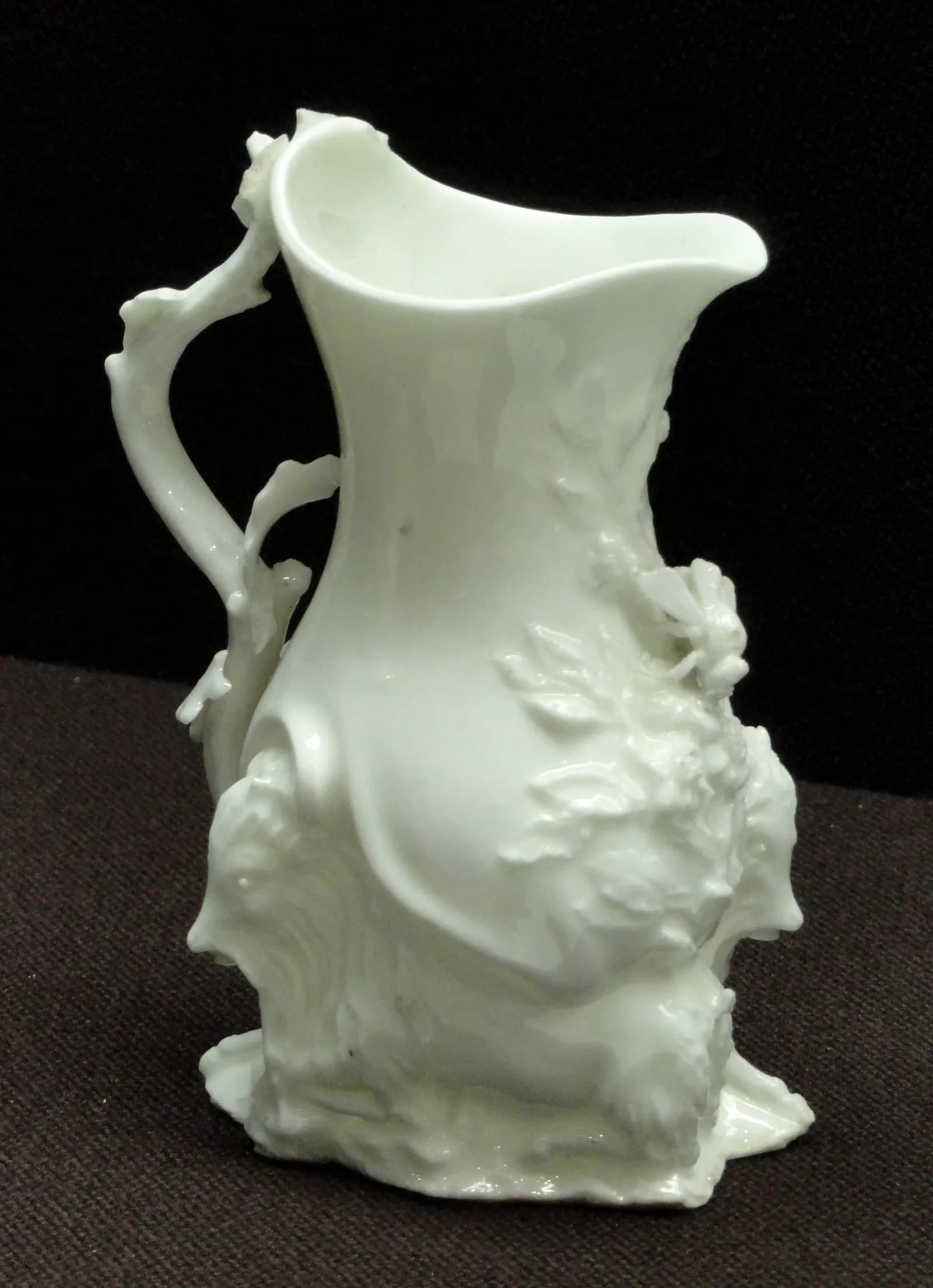
The earliest confirmed Chelsea pieces are the famous "goat and bee" cream jugs, incised with both the factory name and the date 1745. These small vessels, modelled after silver prototypes, represent the earliest dated English porcelains known to exist. They established a pattern that would define much of Chelsea's output: adapting forms and techniques from precious metals to the new medium of soft-paste porcelain.
Four Periods, Four Marks
Chelsea's output is conventionally divided into four distinct periods, each marked by a different symbol impressed or painted on the base of pieces.
The Triangle Period, from approximately 1743 to 1749, produced wares in a "glassy" body that resembled milk-white glass. Most pieces were left undecorated or with minimal ornamentation, continuing the silverware aesthetic. Slipcasting was introduced during this phase, allowing for the production of complex three-dimensional forms.
The factory reopened on 9 January 1750 under the Raised Anchor mark, which it retained until 1752. The paste and glaze were reformulated to produce a clearer, slightly opaque white surface. This period saw the strongest Meissen influence, with Chelsea producing direct copies of two Meissen services in 1751. The raised anchor itself was a symbol of hope and of Saint Nicholas of Myra, the patron saint of seamen.
The Red Anchor Period, from 1752 to 1756, represents what many collectors consider Chelsea's artistic peak. The factory's proximity to the Chelsea Physic Garden, founded in 1673 and already renowned for its botanical collections, inspired a distinctive style of porcelain decorated with botanically accurate plant paintings. An advertisement from 1758 offered plates "enamelled from the Hans Sloane's Plants." Sir Hans Sloane's collection had formed the foundation of the Physic Garden's holdings. This period also produced small "Toys," including scent bottles, bonbonnières, and étuis, many bearing French inscriptions with what catalogues describe as "amorous suggestions."
The Gold Anchor Period, from 1756 to 1769, reflected the ascendancy of French taste. Rich coloured grounds, lavish gilding, and exuberant Rococo forms dominated production. The body now included bone ash, allowing for a wider palette of colours. Elaborate groups featuring seated couples before bocage screens, large garnitures of vases, and tureens shaped as animals, birds, and fish characterised this final phase. It was during this period that George III and Queen Charlotte commissioned a substantial service for the Duke of Mecklenburg-Strelitz, costing £1,200; 137 pieces remain in the Royal Collection today.
European Rivals on the Thames
Chelsea's ambition was explicitly competitive with the royal manufactories of Europe. Meissen, established in 1710 with the patronage of Augustus the Strong of Saxony, had pioneered European hard-paste porcelain and dominated the luxury market. Chelsea copied Meissen designs directly, including the celebrated "Monkey Band" (Affenkapelle), and employed Meissen-trained craftsmen.
By the late 1750s, Chelsea had shifted its attention to Sèvres, the French royal factory established in 1740. The Gold Anchor pieces adopted the Sèvres Rococo style, with its characteristic rich grounds and heavy gilding. The irony, as ceramic historians note, is that Chelsea began to imitate Sèvres precisely as the French factory itself was abandoning the Rococo in favour of Neoclassical restraint.
Local Foundations
The factory's location in Chelsea was no accident. The riverside village, then still separate from London proper, offered suitable premises, access to water transport for materials and finished goods, and proximity to wealthy patrons. The Chelsea Physic Garden provided not only botanical inspiration but also a cultural context that valued scientific accuracy and naturalistic representation.
Excavations in 1843 at Cheyne Row West, where part of the factory had stood, uncovered large quantities of broken figures and kiln debris. More recently, the Chelsea Society has adopted the red anchor symbol as its logo, commemorating the factory's Red Anchor Period from 1752 to 1756. Sprimont Place, a street in modern Chelsea, bears the founder's name.
Closure and Afterlife
Production declined after 1763, possibly reflecting Sprimont's wish to retire. He sold the factory in August 1769 to James Cox, a London dealer, who immediately resold it to William Duesbury of the Derby porcelain works. The final Chelsea sale took place at Christie's beginning 14 February 1770. Duesbury operated the Chelsea works as a subsidiary until 1784, when the buildings were demolished and the remaining moulds, patterns, and workmen transferred to Derby.
The "Chelsea-Derby" wares produced between 1770 and 1784 are often indistinguishable from pure Chelsea or pure Derby pieces, creating enduring challenges for attribution. The factory site itself was built over, though its memory persisted in local lore and in the collections of the Victoria and Albert Museum, which holds over 1,200 Chelsea pieces.
Collecting Chelsea Today
Chelsea porcelain commands substantial prices at auction. In 2003, a hen-and-chickens tureen from the Gold Anchor period sold for £223,650, establishing what was then a record for English 18th-century porcelain. In 2018, a pair of plaice-shaped tureens dating from circa 1755, formerly in the collection of David Rockefeller, fetched $300,000 at Christie's.
The earliest pieces, with their incised triangle marks and glassy bodies, remain the most sought after. The botanical wares of the Red Anchor period, with their distinctive plant paintings, continue to influence ceramic design. Even the more numerous Gold Anchor pieces, with their elaborate gilding and coloured grounds, represent a high point of English Rococo taste.
For residents of modern Chelsea, the factory represents a tangible link to an era when this riverside village produced objects of international significance, rivalling the output of Europe's most prestigious royal workshops from a modest site at the corner of Justice Walk and Old Lawrence Street.