King's Road in Chelsea transformed from a private royal thoroughfare into the epicentre of two global fashion revolutions. The two-mile stretch that runs from Sloane Square to the western edge of Chelsea gave the world both the miniskirt and punk style.
The Boutique That Invented Youth Fashion
In 1955, Mary Quant opened Bazaar at 138a King's Road and changed how the world thought about shopping. The boutique was deliberately different from the stuffy department stores of the era. Quant installed music, offered drinks to customers, and kept long hours that suited young adults rather than traditional shoppers.
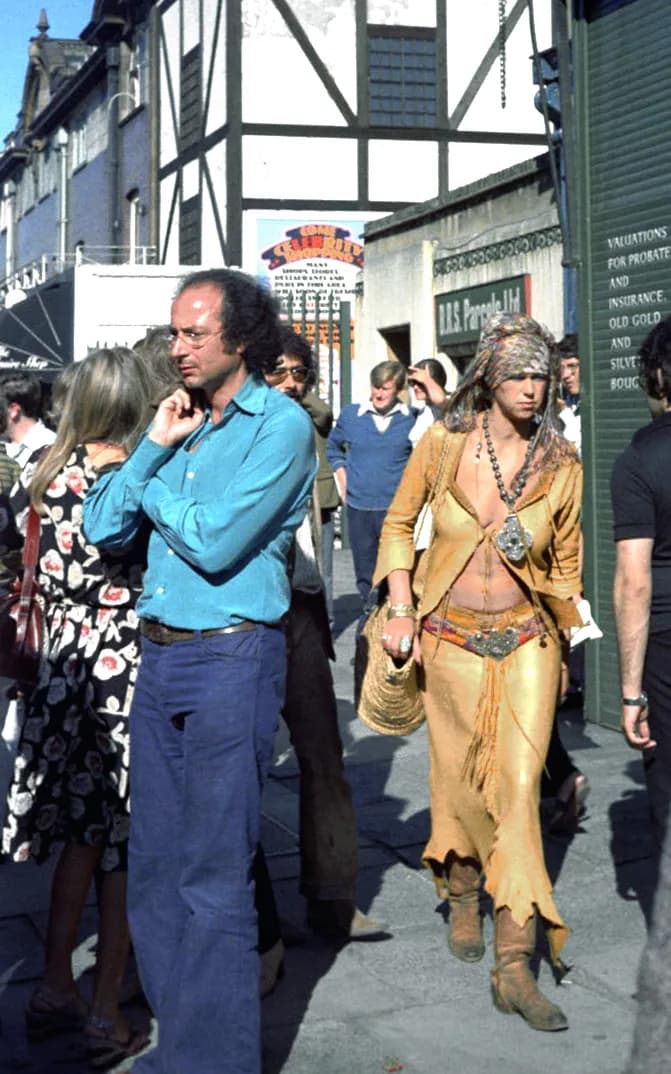
Quant is credited with popularising the miniskirt. She named the garment after her favourite car, the Mini. She said: "It was the girls on the King's Road [during the 'Swinging London' scene] who invented the miniskirt. I was making easy, youthful, simple clothes, in which you could move, in which you could run and jump and we would make them the length the customer wanted. I wore them very short and the customers would say, 'Shorter, shorter.'"
Quant's influence spread rapidly. She won the first Dress of the Year award in 1963. In 1966 she arrived at Buckingham Palace to accept her OBE wearing a cream wool jersey minidress with blue facings. By 2000 she had over 200 Mary Quant Colour shops in Japan alone.
The Psychedelic Era Arrives
Granny Takes a Trip opened at 488 King's Road in February 1966. The boutique, founded by Nigel Waymouth, Sheila Cohen, and John Pearse, was described as the "first psychedelic boutique in Groovy London of the 1960s." It featured in Time magazine's "London: The Swinging City" issue in April 1966.
The shop became famous for its ever-changing façade. In 1966 it displayed giant portraits of Native American chiefs. The following year the front was painted with a pop-art face of Jean Harlow. Later an actual 1948 Dodge saloon car appeared to crash out of the first-floor window. The boutique closed in 1974 after being sold to American buyers in 1969.
Punk's Laboratory at 430 King's Road
The building at 430 King's Road became the laboratory where punk fashion was invented. Vivienne Westwood and Malcolm McLaren opened the boutique in October 1971 as Let It Rock, selling Teddy Boy clothes with a black corrugated iron frontage.
The shop changed names and identities repeatedly. In 1973 it became Too Fast To Live Too Young To Die, referencing 1960s rocker fashions with skull and crossbones signage honouring James Dean. In spring 1974 it became SEX, specialising in fetish and bondage wear. The façade featured four-foot pink foam rubber letters spelling "SEX" and the interior was covered with chickenwire and graffiti from the SCUM Manifesto.
The four original members of the Sex Pistols were customers at SEX. Glen Matlock worked there as a Saturday sales assistant. John Lydon was persuaded by McLaren to audition for the band at the shop in August 1975. Other regulars included Chrissie Hynde, Adam Ant, Siouxsie Sioux, and the "Bromley Contingent" of punk followers.
In December 1976 the shop became Seditionaries: Clothes for Heroes. The brutalist interior sold bondage trousers, unravelling mohair jumpers, and straight-jacket-style tops. Westwood described her motivation: "I was messianic about punk, seeing if one could put a spoke in the system."
The Legacy Continues
Since late 1980, 430 King's Road has operated as World's End. The interior was designed to resemble an eighteenth-century galleon and an Olde Curiosity Shoppe, complete with a large clock that spins backwards and a floor raked at an angle. The boutique remains open today as part of Vivienne Westwood's global fashion empire, which as of 2025 operates 102 stores in 17 countries.
King's Road itself has undergone significant gentrification. The street, which was once described as evoking "an endless frieze of mini-skirted, booted, fair-haired angular angels," remains one of London's most fashionable shopping destinations. The eastern end is identified in the London Plan as one of 35 major centres in Greater London.
The road's royal origins are still visible in its name. It was a private road used by King Charles II to travel to Kew and remained restricted to royal use until 1830. From that exclusive beginning, Chelsea's King's Road democratised fashion twice over: first through Quant's accessible youth styles, then through Westwood's deliberately provocative punk aesthetic. Both movements started in small Chelsea boutiques and spread worldwide.